
 Duane Beckett
Wedding customs throughout history offer some of the most bizarre scenarios imaginable. Many of which sound made up, but that’s not what history tells us. Here’s some of the oddest traditions going.
1. Charivari chaos (Middle Ages to 1800s)
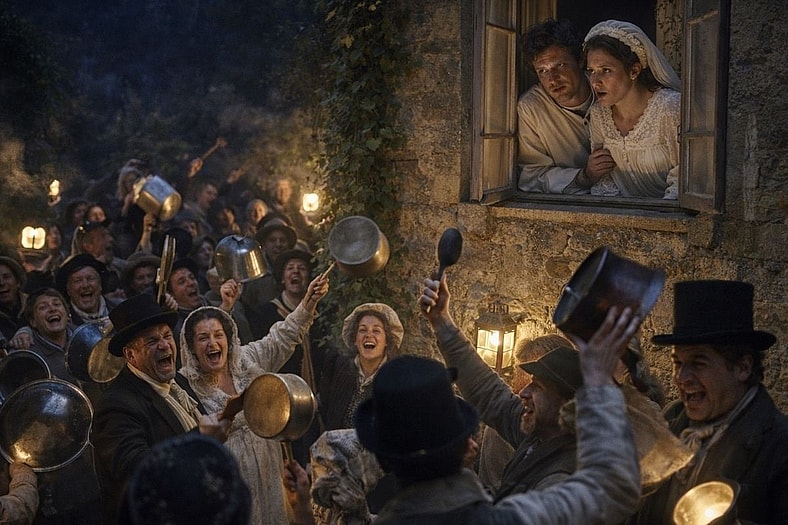
From the Middle Ages through the 1800s in France, later spreading into French Canada and parts of rural America, communities staged a charivari, also called a shivaree, for newlyweds.
Be warned, this is not a sweet send-off. According to information on Wikipedia, neighbors often gathered outside a new couple’s home at night, banging pots, shouting, and mocking the pair in public. Sometimes it was playful, sometimes it was far meaner than that.
Either way, privacy was not part of the package. Newlywed life often began with a racket no one would forget.
2. Jumping the broom (1800s)
When it comes to marriage among enslaved couples, back in the 1800s across the South of America, it sadly had to exist outside of the law.
According to the National Park Service, these couples instead jumped over a broom to mark their commitment in front of family and community. This became a meaningful way to show their relationship in spite of the injustice they faced at that time.
The act carried a genuine emotional weight and in-part helped couples have belonging when the world denied them that opportunity.
3. Bread on the bride’s head (Ancient Rome)
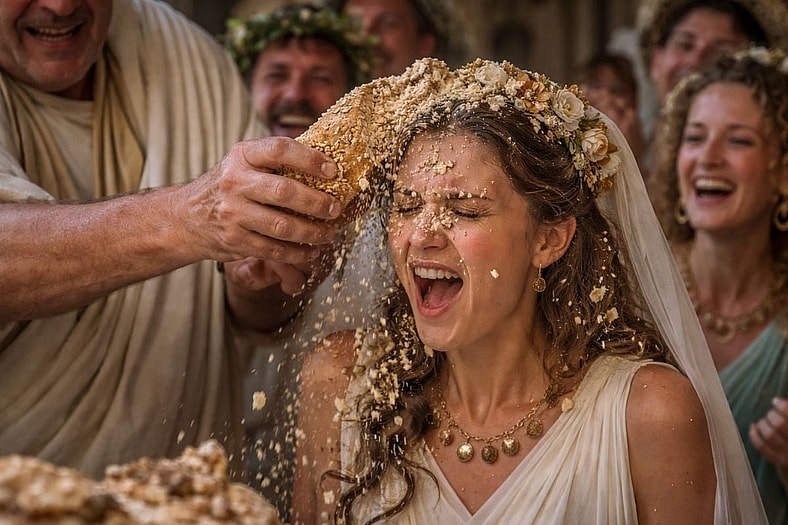
We go back to ancient Rome with this one. During the last centuries BCE and into the early centuries CE, part of the wedding ceremony could involve breaking a barley cake or loaf over the bride’s head.
Gastronomica found that the act was tied to ideas about luck and fertility, which tells you plenty about what marriage was expected to produce. Modern cake cutting feels polished by comparison.
This older version was more blunt, more physical, and honestly a little hard to picture without wincing, especially as barley cake isn’t exactly moist. Still, it was a recognized ritual.
4. Scotland’s blackening ordeal (1800s to early 1900s)
I’ll admit this one sounds like something out of an old prank show gone wrong. In rural Scotland, especially the north-east, the Highlands, and the Northern Isles, blackening turned pre-wedding nerves into a public ordeal.
Wikipedia states that by the late 1800s and early 1900s, friends might capture the bride or groom, cover them in filthy sticky substances, and parade them around town. It was loud, embarrassing, and impossible to ignore.
The idea was often tied to preparing the couple for hardship, though the actual experience sounds truly horrific.
5. Shoes for luck (1800s)
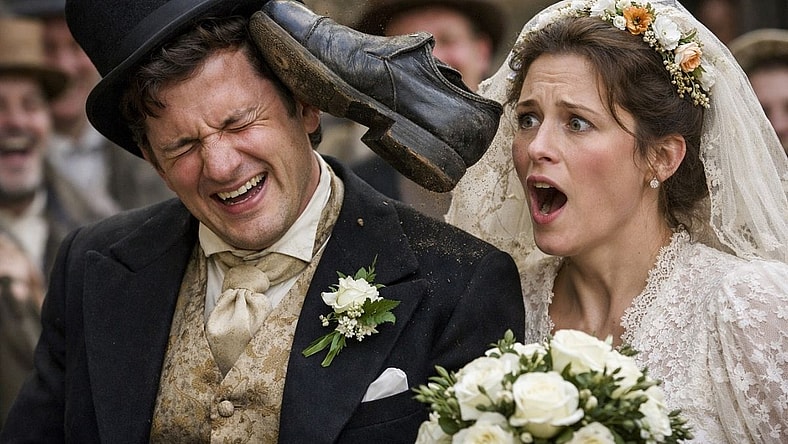
By Victorian times in Britain, throwing old shoes at the bride and groom was common enough that many people saw it as a proper good-luck gesture.
Old folklore links the shoe to authority passing from the bride’s family to the groom, which adds a darker edge to what now sounds silly.
Wikipedia highlights that this custom was especially popular in the 1800s. Today, tossing footwear at a wedding would get you escorted out, but back then, it could be treated as a sign of blessing.
6. Wedding night witnesses (1200s to 1700s)
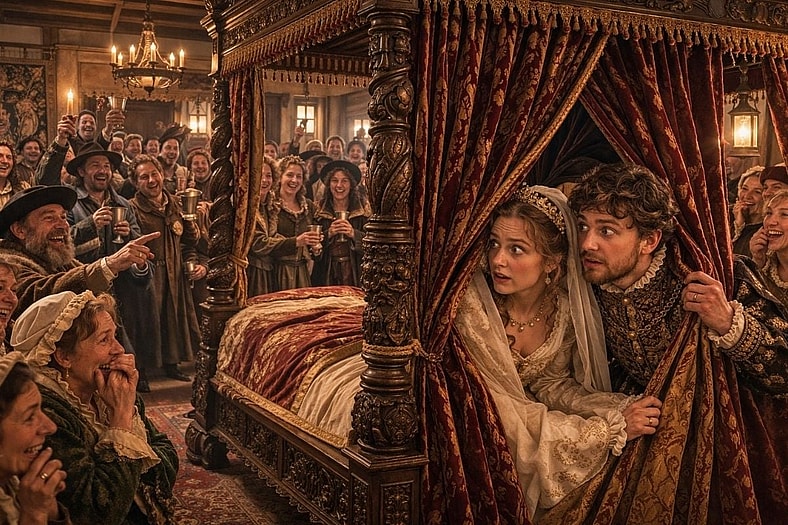
This one is quite shocking as guests did not always stop celebrating at the reception. For centuries in England, Scotland, Scandinavia, and parts of the German-speaking world, some followed the couple all the way to bed.
Wikipedia notes that from roughly the 1200s to the 1700s, bedding ceremonies could include blessings, songs, jokes, and symbolic acts tied to consummation. In some versions, people even threw stockings.
I can barely picture that without thinking of how awkward the room must have felt. Privacy, as we know it, was clearly not on the cards, not even close.